Dental Assistant Classes Online: What Actually Happens in a Hybrid Program
When people hear “dental assistant classes online,” they usually have one of two reactions. Either they’re immediately interested — more flexibility, no commute, work at your own pace. Or they’re skeptical — dental assisting is a hands-on clinical job, how can you really train for it online?
Both reactions are reasonable. And both miss part of the picture.
Online learning doesn’t mean the same thing across all programs. Some programs are almost entirely online and involve very little actual clinical preparation. Others use online delivery as a foundation and stack serious hands-on training on top of it. The difference in outcomes between those two types is significant.
Here’s what online dental assistant training actually involves — specifically in Arch’s hybrid format — and where the line between online content and in-person practice gets drawn.
What “online-first hybrid” means at Arch
Arch describes its program as “online-first hybrid.” That phrase is worth unpacking.
Online-first means that the majority of content delivery happens online. You’re not required to sit in a classroom five days a week. Coursework, lectures, reading, quizzes, and content review are all delivered through an online platform that you can access on your schedule.
Hybrid means that the online coursework is combined with required in-person components — specifically, hands-on clinical lab days in real dental offices. The “hybrid” part is not optional. It’s not a supplemental add-on. It’s built into the program structure because dental assisting requires tactile, physical skill development that cannot happen through a screen.
The result: you get the scheduling flexibility of online learning without sacrificing the clinical preparation that the job requires.
What happens during the online portion
The online coursework covers all the foundational knowledge a dental assistant needs before working chairside. This includes:
Dental science and anatomy
- Tooth morphology and anatomy — naming, numbering, structure
- Oral anatomy: gingiva, alveolar bone, temporomandibular joint, salivary glands
- Dental disease processes: caries, periodontal disease, developmental anomalies
- How treatment plans are formulated and what the assistant’s role is in each
Clinical knowledge and protocols
- Infection control and sterilization — OSHA standards, cross-contamination prevention, PPE protocols
- Dental materials: types, uses, handling, and setting characteristics
- Medical history review: what to look for, when to flag information, medications that affect dental treatment
Procedure-specific preparation
- Restorative procedures (amalgam, composite): setup, instrument tray, assistant role
- Surgical procedures: extractions, suture management, post-op instructions
- Specialty procedures: orthodontic, periodontal, endodontic (basic exposure)
- Dental radiography: radiation safety, film types, digital X-ray systems
RDA exam preparation
- Targeted content aligned to RDA exam domains
- Practice questions, case studies, exam format review
All of this is delivered through a combination of self-paced modules and live Saturday sessions — instructor-led online classes where you can ask questions, review clinical scenarios, and engage with the material alongside your cohort. The live sessions make the online portion interactive, not passive.
What the online portion does NOT do
Here’s where honesty matters.
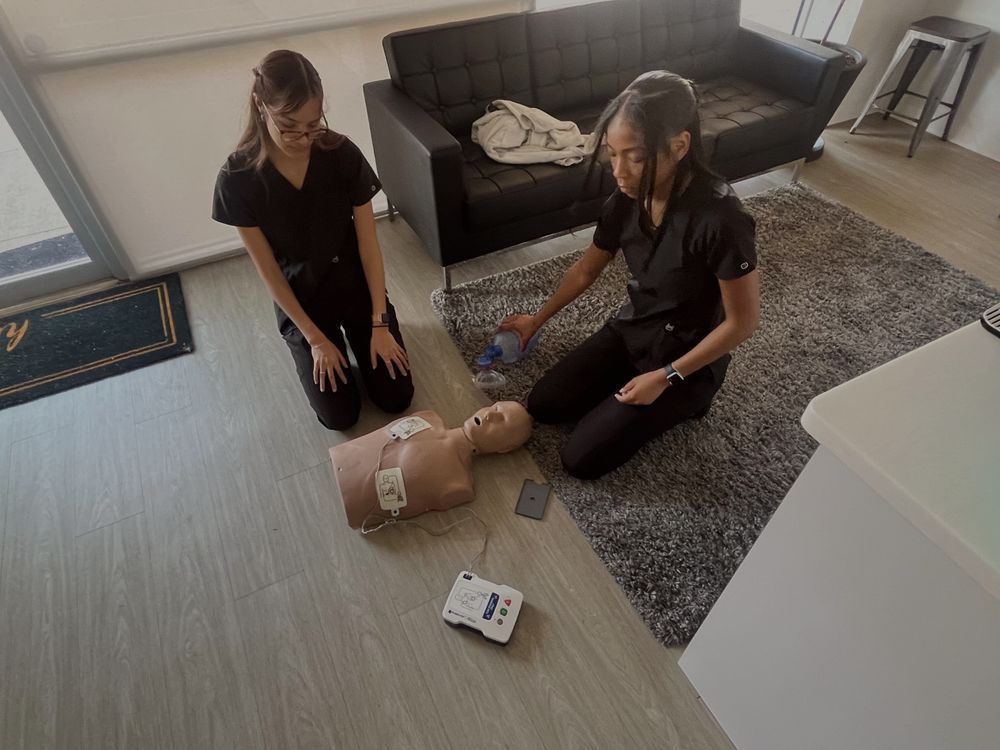
Online coursework cannot teach you to set up a procedure tray correctly under time pressure. It cannot give you the feel of high-volume evacuation technique, or the physical sense of what “proper instrument exchange” actually requires. It cannot replicate the experience of working with an actual patient — the movement, the communication, the noise, the coordination.
No online curriculum can do those things. Any program that claims otherwise is overpromising.
The online portion of Arch’s program handles the knowledge layer. The in-person lab days handle the skills layer. You need both, and they’re sequenced so that the online foundation prepares you to make the most of the in-person time.
What happens during the in-person lab days
Arch’s program includes four in-person lab days total — two full weekends at weeks 4 and 8. Each day runs approximately 9 hours.
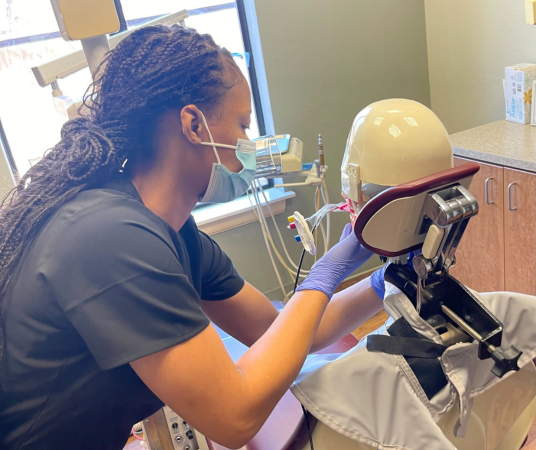
Here’s the important part: these lab days don’t happen in a classroom. They happen inside real, working dental offices through Arch’s partnerships with local dental practices. That means real equipment, real operatories, real clinical environments.
Lab weekend 1 (week 4) covers:
- Instrument identification, tray setup, and procedural organization
- Chairside assisting technique — positioning, anticipation, four-handed dentistry
- Radiography technique: hands-on X-ray positioning and exposure
- Moisture control and isolation
- Patient communication and professional conduct in a clinical setting
Lab weekend 2 (week 8) covers:
- Advanced procedural assisting with more complex technique requirements
- Coronal polishing and expanded-function skills (RDA-level, state-specific)
- Radiography competency sign-off
- Clinical proficiency evaluations
- Professional readiness review
By the time both lab weekends are complete, students have approximately 36 hours of direct, in-person clinical training in real dental offices. That’s a meaningful amount of clinical exposure — and it happens in the actual environment where dental assistants work, not a simulation of it.
Take-home lab kits: practice between sessions
One detail that makes Arch’s program stand out: students receive a take-home lab kit at enrollment. This includes instruments and supplies to practice clinical skills at home between sessions — throughout the online phase and between lab weekends.
Most programs wait for in-person sessions to introduce any hands-on work. Arch’s take-home kit makes clinical practice continuous rather than episodic, so by the time lab weekend 1 arrives, you’re not encountering instruments for the first time.
The schedule in practice
Here’s what a typical week in the online phase looks like:
- Monday–Friday: Self-paced online coursework, modules, and content review (approximately 8–12 hours/week of independent study)
- Saturday: Live instructor-led session (approximately 2–3 hours, scheduled)
- Ongoing: Practice with take-home lab kit as needed
During lab weekends (weeks 4 and 8):
- Saturday and Sunday: 9-hour in-person clinical training in a partnered dental office
The schedule is demanding but designed to work around adult learners who may have existing jobs or family commitments. The online flexibility carries the heavy lifting on scheduling, while the lab weekends are concentrated and finite.
What students say catches them off guard
Most students going into an online-first program expect the online part to be the challenge. In practice, the opposite tends to be true.
The online coursework — while substantial — is self-paced and flexible. Students work through it at their own speed, revisit content they want to review, and attend Saturday sessions to fill in gaps. It’s manageable for most adult learners.
What catches people off guard is the in-person lab days. Not because they’re too hard, but because they’re the point at which everything clicks. Being in an actual dental operatory, handling instruments, working chairside — the transition from screen-based learning to real clinical practice is an adjustment. Students who show up to lab weekend 1 prepared (having done the online coursework and practiced with the take-home kit) report that the experience is intense but energizing. It’s when the training starts feeling real.
The other common surprise: how quickly the 10 weeks go. Students who expected to feel rushed at the end frequently report that the pace felt appropriate — challenging without being overwhelming — and that they felt genuinely ready to sit for the RDA exam at the end.
Comparing online hybrid to fully in-person programs
If you’re weighing an online-first hybrid against a traditional full-time in-person program, here’s the honest comparison:
| Online-first hybrid (Arch) | Traditional in-person | |
|---|---|---|
| Schedule flexibility | High — self-paced online coursework | Low — fixed daily class schedule |
| Commute | Minimal (only lab weekends) | Daily |
| In-person clinical hours | ~36 hours (4 full lab days in real offices) | Varies widely — often classroom labs |
| Total cost | $2,950 | $5,000–$15,000+ |
| Program length | 10 weeks | 9–12 months typically |
| Training environment | Real dental offices | Usually classroom simulation |
The scheduling flexibility and lower cost of the hybrid model don’t come at the expense of clinical preparation — they come at the expense of campus overhead and administrative structure that traditional programs carry. Arch stripped the program down to what actually matters: the knowledge and the clinical time.
Is online dental assistant training right for you?
Online-first hybrid training works well for students who:
- Are self-motivated and able to manage independent study without daily in-person accountability
- Have scheduling constraints that make traditional full-time programs difficult
- Learn well from structured online materials and can engage meaningfully with content before applying it in person
- Are physically present for the required in-person lab weekends
It’s not the right fit for students who need constant in-person supervision to stay on track, or who can’t commit to the two lab weekends.
The majority of adult learners looking to change careers find the format more practical than traditional classroom schedules — and the outcomes are equivalent when the in-person training component is well-designed.
Looking for more details on how the program works?
The program details page has the full breakdown of curriculum, lab day scheduling, and what to expect at enrollment. And if you want to find a location near you before committing, check out Arch’s locations directory.
Ten weeks. Online-first. Real dental offices. Debt-free.
Employment and salary data referenced from the Bureau of Labor Statistics (BLS.gov, 2026) and Glassdoor data for dental assistant roles.
You're only a few months from the medical assistant career you deserve.