How Long Does It Take to Become a Dental Assistant? Arch's 10-Week Accelerated Timeline
The honest answer to “how long does it take to become a dental assistant” is a lot shorter than most people expect. With the right program, you can go from no experience to trained, certified, and working in a dental office in roughly three to four months — and the actual training at Arch is just 10 weeks.
Here’s exactly what that timeline looks like, broken down step by step, so you know what you’re signing up for before you start.
Before training: enrollment (a few days to 1 week)
Getting into Arch is straightforward. No prerequisites, no waitlists, no entrance exams. You’ll talk with the admissions team, review the program structure and tuition, choose a payment plan, and lock in your start date.
What you need:
- A high school diploma or GED
- A valid ID
- Willingness to learn — no dental or healthcare experience required
No college transcripts. No science courses. No standardized tests.
The 10-week training breakdown
Weeks 1–3: Building the foundation (online)
The first three weeks are delivered online through live, instructor-led Saturday sessions, with weekday assignments you complete on your own schedule.
- Dental terminology and anatomy — tooth numbering, surfaces, structures, and how they relate to clinical work
- Infection control — sterilization theory, OSHA standards, PPE protocols, instrument processing
- Introduction to dental instruments — identifying and understanding common hand and rotary instruments
- Patient communication — greeting patients, taking histories, explaining procedures, managing anxiety
- Radiography fundamentals — X-ray theory, safety protocols, and positioning concepts
By week 3, you have the vocabulary and knowledge base to start hands-on clinical work.
Week 4: First lab weekend (in-person)
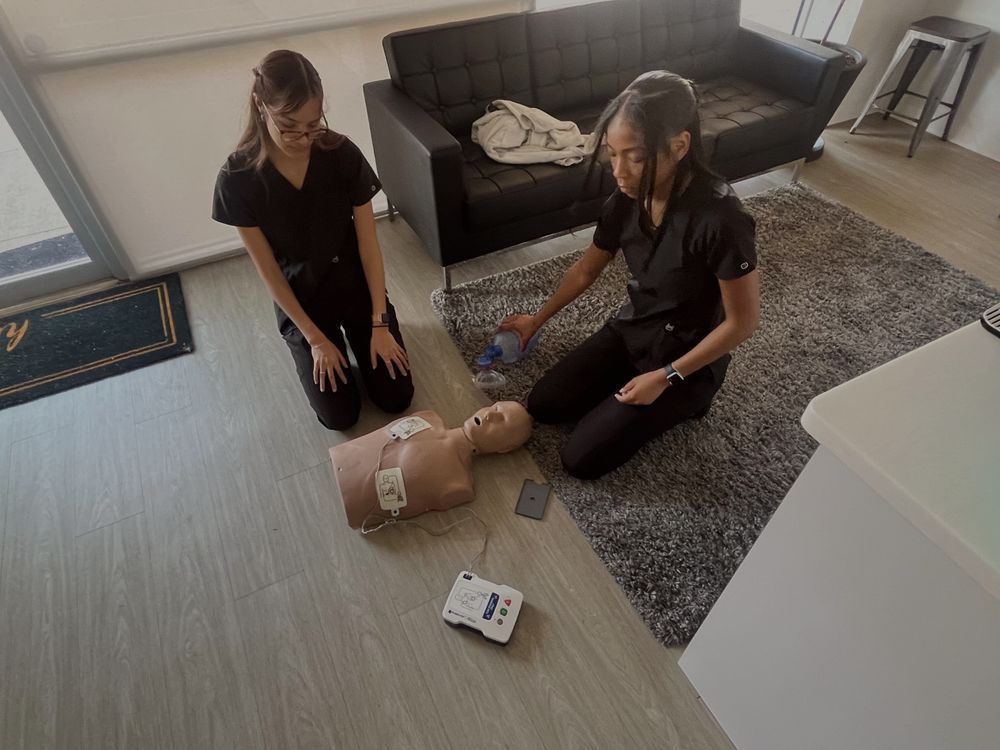
Two days (Saturday and Sunday, 9 hours each) inside a real dental office — not a classroom lab:
- Dental X-ray technique — sensor placement, exposure settings, patient positioning, radiation safety
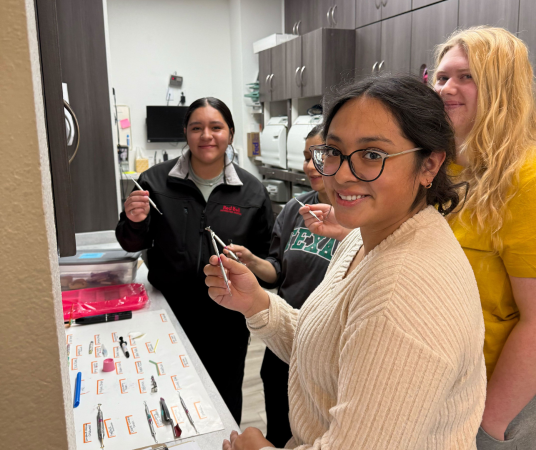
- Instrument handling — recognizing, passing, and managing instruments during procedures
- Sterilization procedures — autoclave operation, instrument processing, operatory turnover
- Chairside assisting basics — positioning, suction technique, four-handed dentistry fundamentals
You’re working with actual dental equipment in an actual clinical environment, supervised by experienced instructors.
Weeks 5–7: Expanding clinical and administrative skills (online)
Back online, building on your lab experience:
- Dental materials — mixing impressions (alginate, PVS), preparing cements, handling composites, fabricating temporary restorations
- Advanced chairside assisting — assisting during restorations, extractions, crown preps
- Dental charting — documenting treatment accurately
- Administrative skills — scheduling, insurance verification, billing basics, EHR documentation
- Take-home lab kit practice — reinforcing clinical skills between lab weekends
Week 8: Second lab weekend (in-person)
Two more intensive days (9 hours each) in a real dental office:
- Advanced radiography — panoramic imaging, troubleshooting positioning errors
- Impression taking — full-arch alginate impressions and model pouring
- Complex chairside scenarios — smoother instrument exchanges, better anticipation during multiple procedure types
- Infection control mastery — protocols feel automatic by this point
This is the weekend where confidence clicks. You’ve studied, practiced at home, and now the skills are becoming second nature.
Weeks 9–10: Certification prep and career readiness (online)
The final stretch:
- Comprehensive skills review — reinforcing everything you’ve learned
- RDA exam preparation — targeted content review, practice questions, test-taking strategies
- X-ray certification preparation — specific prep for radiography credentials
- Career readiness — resume writing, interview techniques, job search strategies
After training: certification and employment (3–6 weeks)
Certification (1–3 weeks post-graduation)
Arch integrates RDA exam prep throughout the program, so you’re ready to sit for the Registered Dental Assistant exam shortly after completing training. The credential tells employers your skills are verified.
Job search (2–4 weeks)
Dental assistant jobs are in consistent demand nationwide. The BLS projects continued growth, and dental offices are actively hiring trained, credentialed assistants. Your job search toolkit:
- Job boards — Indeed, ZipRecruiter, LinkedIn
- Dental office and DSO career pages
- Connections from training — the dentists you trained with may have openings
- School career support
Total timeline: decision to employment
| Phase | Duration |
|---|---|
| Research and enrollment | A few days to 1 week |
| Training | 10 weeks |
| Certification exam | 1–3 weeks post-graduation |
| Job search and hiring | 2–4 weeks |
| Total | Approximately 3–4 months |
Compare that to a community college program (1–2 years plus prerequisites) or a hygienist program (2–4 years). The difference is massive — especially when you factor in the salary you’d earn during those extra months of working instead of studying.
The financial advantage of starting sooner
Every month spent in a longer program is a month you’re not earning. At the national median salary of approximately $46,000–$48,000/year (BLS, 2026):
- Starting 12 months sooner means earning approximately $44,000–$48,000 during that time
- Factor in Arch’s $2,950 tuition vs. $10,000–$25,000 for longer programs, and the financial gap widens further
- Graduating debt-free means every dollar of your salary goes toward building your life
How Arch compares to other training paths
Community college dental assistant program
- Length: 9–12 months (sometimes longer with prerequisite requirements)
- Cost: $5,000–$15,000
- Format: In-person weekday classes and campus labs
- Earnings lost during training: $35,000–$48,000 (a full year of missed salary)
- Debt at graduation: Often $5,000–$10,000+
Associate’s degree in dental assisting
- Length: 2 years
- Cost: $10,000–$25,000+
- Format: Full-time campus attendance, includes general education courses
- Earnings lost during training: $70,000–$96,000 (two years of missed salary)
- Debt at graduation: Often $15,000–$25,000+
Arch Dental Assistant School
- Length: 10 weeks
- Cost: $2,950
- Format: Online-first with 4 in-person lab days in real dental offices
- Earnings lost during training: Minimal — you can keep working weekdays
- Debt at graduation: $0
The clinical skills and certification outcomes are comparable — but the time, cost, and debt are dramatically different.
Common questions about the timeline
“Can I really learn everything in 10 weeks?” Yes. Every hour is focused on job-essential skills — no general education filler. You learn the knowledge online and practice the skills in real dental offices. Take-home lab kits keep you building confidence between sessions.
“Can I work while training?” Arch is designed for it. Online sessions are on Saturdays, weekday coursework is self-paced, and in-person labs are only 4 days total. Your weekdays stay free.
“What if I have no healthcare experience?” Arch’s program is built for beginners. No prerequisites, no prior experience needed.
What you’ll be qualified to do after 10 weeks
Graduates of Arch’s program are trained and ready for:
- Chairside assisting — supporting dentists during exams, cleanings, fillings, extractions, crowns, and other procedures
- Dental radiography — taking diagnostic X-rays with proper technique and safety protocols
- Infection control — maintaining sterilization standards that protect patients and staff
- Patient care — communicating clearly, managing anxiety, providing aftercare instructions
- Office administration — scheduling, charting, insurance processing, and record management
- RDA certification — sitting for the Registered Dental Assistant exam with confidence
These are the exact skills dental offices list in their job postings. The 10-week timeline is focused on making you competitive for those positions — nothing more, nothing less.
Who this program is designed for
Arch’s accelerated timeline works best for:
- Working adults — online-first format keeps your weekdays free
- Career changers — no prerequisites or healthcare background needed
- Parents and caregivers — study when it fits your schedule, not someone else’s
- People who want to start earning quickly — 10 weeks of training, not 10 months
- Cost-conscious learners — $2,950 total, graduate debt-free
Ready to start?
- Explore the program: Program details
- Review tuition and payment plans: Tuition
- Talk to our team: Contact
- Apply: How to apply
You're only a few months from the medical assistant career you deserve.