What to Look for in a Dental Assistant School: A No-Nonsense Guide
If you’re evaluating dental assistant schools, the variety can feel overwhelming. Traditional in-person programs, online-only courses, community college options, vocational schools — each with different timelines, costs, and levels of actual clinical preparation.
Here’s what to look for, what to avoid, and how the Arch Dental Assistant School 10-week hybrid program fits into the landscape.
What a dental assistant school needs to actually deliver
Dental assisting is a clinical, hands-on job. The moment you walk into a dental office for your first shift, you’re expected to seat patients, assist during procedures, take X-rays, maintain infection control standards, and handle administrative tasks — sometimes all in the same morning. A dental assistant school that doesn’t prepare you for all of that isn’t doing its job.
Here’s what quality dental assistant training covers:
Clinical skills
- Chairside assisting — the core of the job. Instrument passing, suction, tissue retraction, and four-handed dentistry technique used during every procedure
- Dental radiography — taking bitewings, periapical, and panoramic X-rays. Correct positioning, radiation safety protocols, and image quality evaluation
- Infection control — autoclaving instruments, disinfecting operatories, PPE protocols, OSHA bloodborne pathogen standards, and sharps management
- Dental materials — impression materials, cements, composites, temporary restorations. Mixing ratios, working times, and handling technique
- Patient preparation — seating and draping patients, reviewing medical histories, taking vital signs where required, and managing pre-procedure communication
Administrative skills
- Appointment scheduling and patient flow management
- Dental charting and clinical documentation
- Insurance verification and basic billing codes
- Electronic health records and HIPAA compliance
- Patient communication and front-office support
A dental assistant school that only covers one of these skill sets — or covers both superficially — produces graduates who aren’t ready for day one.
Types of dental assistant schools: how they compare
Traditional in-person programs
Full-time attendance at a physical location, typically 5 days per week. Solid clinical preparation — but inflexible scheduling rules out most working adults, parents, and people with existing commitments.
Community college programs
1–2 year programs that include general education courses alongside dental training. Lower cost in some cases, but significantly longer timeline. A dental assisting credential takes 12–24 months at a community college vs. 10–16 weeks at a focused career program.
Online-only programs
Fully online dental assistant courses exist, but they cannot adequately teach clinical skills. You cannot develop chairside technique, radiography positioning, or sterilization protocols through videos and simulations alone. Employers know this — and so do the externship sites that evaluate graduates.
Hybrid programs
Online coursework for theory and administrative content; in-person labs for clinical skills. This model does what online-only programs claim to do — genuinely flexible scheduling — while still delivering the hands-on training that chairside work requires.
Arch Dental Assistant School is a purpose-built hybrid dental assistant school.
How Arch Dental Assistant School structures the 10 weeks
Online coursework (throughout 10 weeks)
Online sessions cover everything that can be effectively learned through instruction and study:
- Dental anatomy, terminology, and oral health fundamentals
- Infection control standards: OSHA, CDC guidelines, sterilization theory
- Dental materials: properties, mixing, and clinical application principles
- Radiography: types, positioning theory, radiation safety, and ALARA principles
- Administrative skills: charting, scheduling, insurance, HIPAA, EHR basics
- RDA certification exam preparation integrated throughout
4 in-person lab days (9 hours each)
Two weekends — weeks 4 and 8 — each consisting of two full lab days. This is where clinical skills are developed:
Weekend 1 (Week 4):
- Infection control and sterilization: hands-on autoclaving, operatory disinfection, PPE donning/doffing
- Dental materials: mixing impressions (alginate, PVS), cements, composites, and temporary restoration materials
- Operatory setup and breakdown: tray assembly, instrument identification, four-handed dentistry positioning
Weekend 2 (Week 8):
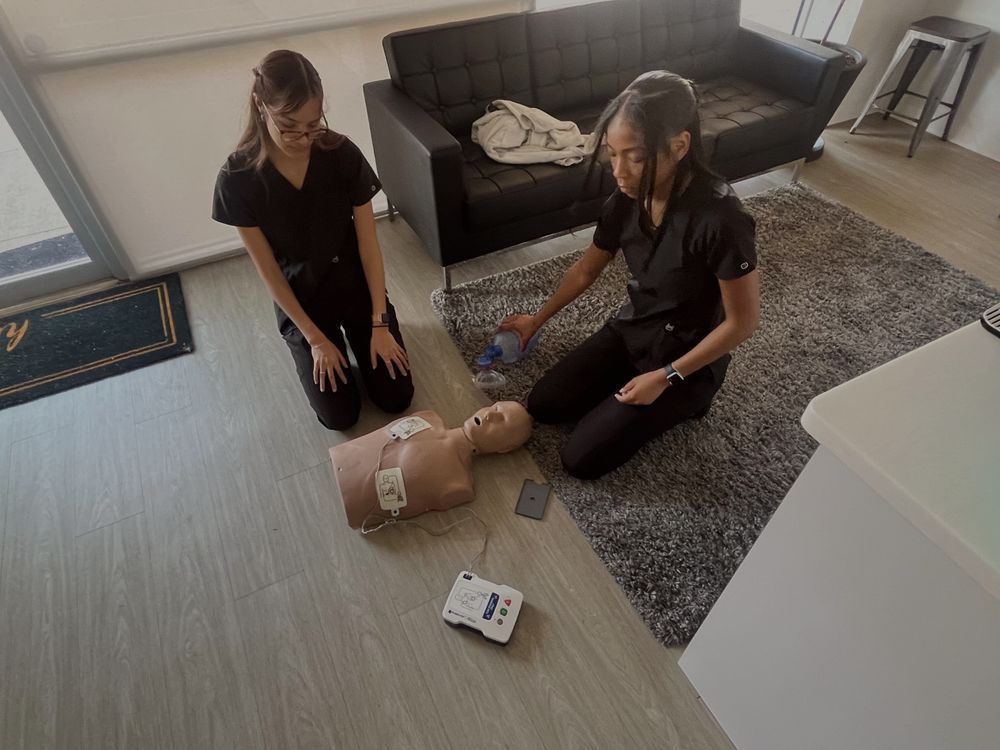
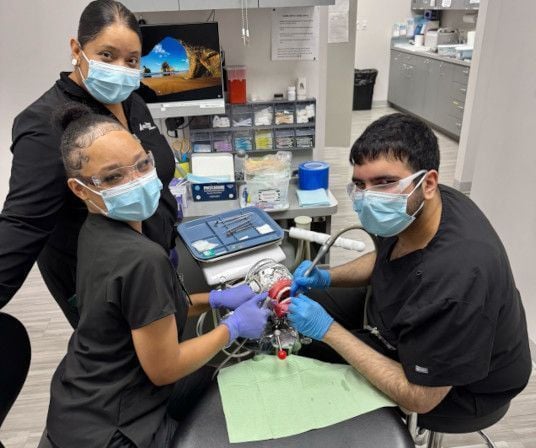
- Chairside assisting: instrument passing technique, suction, retraction, material passing during simulated procedures
- Dental radiography: positioning patients, placing sensors and film, taking bitewings and periapicals
- Patient preparation: seating, draping, medical history review, clinical workflow
All lab days are held in real dental office environments — the same equipment, layout, and workflow you’ll encounter on the job. Instructors provide direct, specific feedback throughout.
What sets strong dental assistant schools apart
- Clinical training is real and supervised — not just videos and quizzes. Hands-on practice with an instructor watching and correcting.
- RDA or equivalent certification prep is built in — exam preparation should be integrated throughout the curriculum, not crammed into the last session.
- Tuition is transparent and all-inclusive — know exactly what you’re paying before you commit.
- Flexible payment options — especially important for students who are working or managing family expenses during training.
- No unnecessary prerequisites — quality programs are designed for beginners. Prior dental experience is not required.
What red flags look like
- No in-person clinical component — chairside skills require physical practice
- Vague or hidden tuition — get the full cost in writing before committing
- No certification exam preparation — gaps here reduce your value to employers
- High-pressure enrollment tactics — legitimate programs give you time to decide
Total cost and the debt-free model
The all-inclusive cost for Arch Dental Assistant School is $2,490. This covers all 10 weeks of online coursework, all 4 in-person lab days (36 total lab hours), RDA exam preparation, and program materials. No financial aid is accepted — no student loans, no debt at graduation.
Payment plans are available to spread the cost across the program.
At $2,490, the total training cost for a dental assisting career is comparable to a single month of community college tuition at many institutions — and the timeline is 10 weeks vs. 1–2 years.
Job outlook and salary
The BLS projects 7% growth in dental assistant employment through 2032. The national median salary is $45,941 per year. Entry-level positions typically start in the $32,000–$38,000 range.
Get started with Arch Dental Assistant School
- Full curriculum: Program details
- Tuition and payment plans: Tuition
- Ask anything: Contact us
- Apply now: How to apply
You're only a few months from the medical assistant career you deserve.